Upper cervical chiropractic family care means one measured, gentle approach to the top of the neck, adapted to every age. At our Wyomissing practice, that can be a feather-light check for a newborn, posture and sports screening for children and teens, and balance-focused care for seniors, with every correction based on that person's own findings.
How one careful approach to the upper neck adapts to every stage of life — from the doctors at Keystone Specific Chiropractic Center in Wyomissing, PA.
Most families come to us one person at a time. A parent with migraines books a visit and, a few months later, asks whether their son's posture or their mother's dizziness is worth a look. That deserves a straight answer, because a newborn, a teenage wrestler and a seventy-eight-year-old grandmother are not the same patient. This guide walks through what stays the same across a family, what changes at each age, and where the honest limits are.
Why the Upper Neck Matters at Every Age
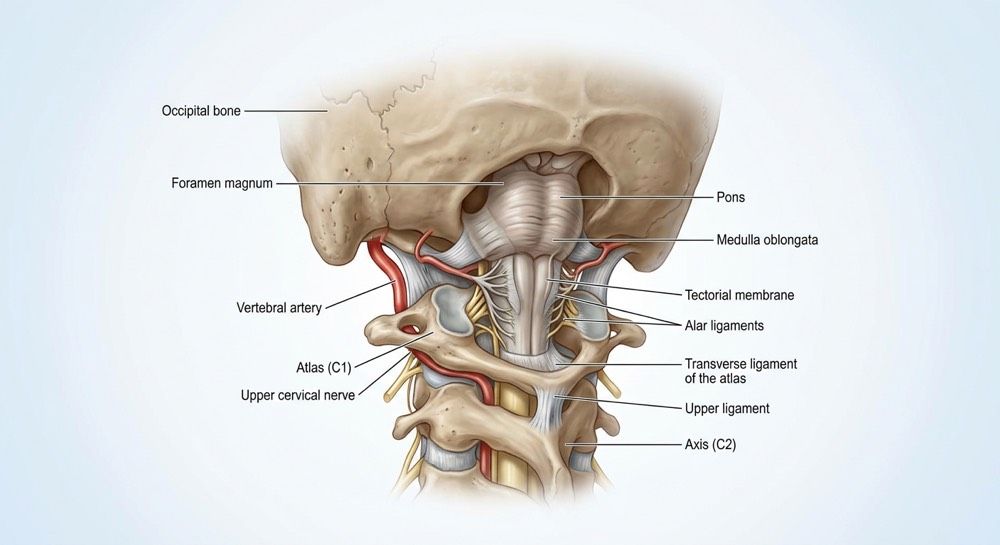
The upper neck matters at every age because the atlas (C1) and axis (C2) surround the brainstem at every age. The anatomy does not change between a newborn and a senior, so the reason for checking it does not change either.
The brainstem passes through the opening of the atlas and helps coordinate posture, balance, breathing rhythm and the stress response. Our overview of the atlas and axis explains why two small vertebrae carry so much influence. When the atlas sits out of position, the body compensates: the head tilts, the shoulders level themselves around it, and the muscles at the base of the skull work harder than they should. A child, a parent and a grandparent can all live with that kind of compensation for years without knowing it is there.
What changes from person to person is not the target. It is how the target is measured, how much force the correction uses, and what we expect a good result to look like.
What Changes From One Age to the Next?
The core method stays the same for everyone: measure first, correct only when the findings support it, then confirm the change held. What changes with age is the size of the patient, the tools used to examine them, and the amount of pressure a correction requires.
For adults, care is built on precise digital X-rays and a painless infrared scan along the spine, the same objective picture described in our post on infrared scanning and digital X-rays. For infants and young children, our doctors lean much more on a careful history, observation and gentle hands-on assessment, and imaging is used only when it is clearly warranted. For seniors, the exam pays close attention to bone health, medications and balance history before anything else is decided.
The force involved also scales down sharply. An adult correction is already light and specific, with no twisting or cracking. A correction for a baby uses only soft fingertip pressure, adapted to the baby's size and stage of development. If you are new to the method entirely, start with our explainer on what upper cervical chiropractic care is, then come back to the age-specific sections below.
Newborns and Infants: A Gentle First Check
A newborn check is a gentle screening, not a treatment for a diagnosis. Our doctors look at how the baby holds and turns the head, how the neck muscles feel, and whether anything in the birth history suggests the upper neck took unusual strain.
Some parents wonder whether birth strained their baby's neck, especially after a long labor or a forceps- or vacuum-assisted delivery. Most babies come through birth without any lasting effect. Some parents notice a strong preference for turning the head one way, trouble latching on one side, or a baby who seems uncomfortable lying flat, and they ask whether the neck could be part of it. It is a fair question to check, and a gentle exam is a reasonable way to check it.
What we do not do is promise that a newborn adjustment will fix colic, reflux, sleep problems or ear infections. The research on chiropractic care for those concerns is limited, and parents deserve to hear that plainly. A 2012 Cochrane review of manipulative therapies for infantile colic found the six available trials too small and of insufficient quality to draw confident conclusions. Your pediatrician remains your baby's primary doctor, and anything that looks like illness belongs with them first. Before an infant or child visit, parents can fill out our pediatric history form so the first conversation starts with the details that matter.
Toddlers and School-Age Children
For toddlers and school-age children, the focus shifts to the bumps of ordinary childhood and to posture as the body grows. Falls off playground equipment, tumbles down stairs and long hours hunched over a tablet all load the top of the neck.
Children are rarely good at describing what feels wrong, so our doctors watch instead. A head that tilts in school photos, one shoulder sitting higher than the other, or a child who complains of headaches after screen time are the kinds of patterns worth a closer look. Use of chiropractic care in children is less common than many parents assume: the National Center for Complementary and Integrative Health reports that 3.4 percent of children age 4 to 17 used chiropractic care in 2017. That is one reason parents often arrive with a lot of questions, and we welcome them.
When a correction is indicated for a child, it is quick, low-force and calculated from what the exam found. Children usually tolerate it easily. Many parents sit in on the visit, which we encourage, so they can see exactly what is being done and why.
How Is Upper Cervical Care Adapted for Teenage Athletes?
For teenage athletes, care centers on the hits, falls and collisions that come with sport, and on catching a problem before it turns into a recurring headache or a stiff neck that never quite settles. The correction itself stays gentle; what changes is how closely we follow a teen through a season.
Across Berks County, fall and winter mean football, soccer, field hockey, wrestling and basketball, and every one of them can jolt the upper neck. A hard tackle or a fall to the mat produces the same rapid back-and-forth motion as whiplash in a car accident, just on a smaller scale. A teen who starts getting headaches, neck stiffness or trouble concentrating after a hit should be evaluated by their physician or athletic trainer first, especially if a concussion is possible. Once serious injury is ruled out, an upper cervical evaluation can check whether the top of the neck was knocked out of position.
Teenagers also go through growth spurts that change posture quickly. A check during those years gives a baseline to compare against later, which is useful whether or not anything needs correcting.
Pregnancy and the Postpartum Months
During pregnancy, upper cervical care is about comfort and balance while the body changes week by week. The correction is performed with the expectant mother positioned comfortably and safely, never lying in a way that puts pressure on the belly.
Back pain is a normal part of pregnancy for many women. The American College of Obstetricians and Gynecologists notes that backache is one of the most common pregnancy problems, especially in the later months, and that for many women it lingers for months after giving birth. As the center of gravity moves forward, the whole spine adjusts, and the upper neck has to keep the head level on top of all that change. A well-positioned atlas gives the rest of the spine a more stable starting point.
After the baby arrives, new demands take over: feeding positions, carrying a car seat, and very little sleep. Our earlier post on chiropractic care during pregnancy covers more of the general background. Expectant mothers should always keep their OB/GYN or midwife informed of any care they receive, and we are glad to coordinate.
Adults Juggling Work, Commutes, and Family
For adults, upper cervical care is usually about symptoms that have been tolerated too long: headaches, neck and shoulder tension, poor sleep, or old injuries that never fully settled. Adults also tend to be the family member who notices a pattern in everyone else.
A typical adult in our Penn Avenue office drives Route 422 or the Warren Street Bypass every day, works at a screen, and carries the stress of a household. Each of those pulls the head forward of the shoulders and adds load to the top of the neck. Adult care follows the measure-first sequence described in our approach to care: history, examination, imaging, an infrared scan, and a correction only when the findings support one.
Adults also set the tone for the family. A parent who understands their own care is in a much better position to decide whether a child or an aging parent should be evaluated, and to ask the right questions when they are.
Can Upper Cervical Care Help Seniors Stay Steady on Their Feet?
Upper cervical care may support balance in some older adults by addressing one structural factor in how the head and neck sense position, but it is not a fall-prevention program on its own. It works best alongside strength training, vision and hearing checks, medication reviews and a safer home.
Falls are one of the most serious risks of later life. According to the Centers for Disease Control and Prevention, more than one out of four older people falls each year, but less than half tell their doctor, and falling once doubles the chances of falling again (CDC, Facts About Older Adult Falls, September 2026). The upper neck contributes to balance because the joints and muscles at the top of the spine constantly report the head's position to the brain. When that signal is distorted, some people feel less steady.
Care for seniors is adapted to bone density, arthritis and any history of surgery, and the correction remains light and specific. Our earlier post on upper cervical chiropractic for seniors covers mobility and comfort in more detail. Any new dizziness, a sudden change in balance, or a fall should be reported to a physician first.
What a Family Evaluation Looks Like at Keystone Specific
Every family member gets an individual evaluation, even when several people come in during the same week. The questions, the exam and the decision about whether to correct anything are made for each person separately.
For adults and older children, the first visit usually includes a consultation, an examination, digital imaging and an infrared scan, with any correction scheduled once the findings have been reviewed. Our post on what to expect at your first visit walks through that appointment step by step. For infants and toddlers, the visit is shorter and centered on the history and a hands-on assessment, with a parent present the whole time.
Families often find it helpful to compare notes afterward. A grandparent's balance concerns, a parent's headaches and a child's posture can look unrelated until everyone hears the same explanation of how the upper neck works.
What Family Upper Cervical Care Can and Cannot Promise
Upper cervical care can check one specific structural factor, correct it gently when the findings support it, and measure whether the change held. It cannot diagnose or cure disease, replace a pediatrician or physician, or guarantee a particular result for any family member.
Some families notice changes across the household: fewer headaches for a parent, better posture for a child, more confidence on the stairs for a grandparent. Others find that one person benefits and another does not need care at all. Both outcomes are fine. The point of measuring first is to recommend care only where the findings support it, and to say so clearly when they do not.
Frequently Asked Questions
At What Age Can a Baby Have a First Upper Cervical Check?
A baby can be checked in the first weeks of life, once parents feel ready and the pediatrician has completed routine newborn care. The check is a gentle screening of head position and neck movement, not a forceful adjustment. If a correction is indicated, it uses fingertip pressure. If the delivery was difficult or assisted, mention it, along with any concern your pediatrician has raised.
Does a Child's Correction Use the Same Pressure as an Adult's?
No. A child's correction uses far less pressure than an adult's, scaled to the child's size, age and stage of development. For infants it is only soft fingertip pressure. Older children receive a quick, light correction calculated from their own findings, and a parent is welcome to stay in the room for every visit.
What Signs in a Child Might Point to an Upper Neck Problem?
Parents often notice a head that tilts in photos, one shoulder sitting higher, frequent complaints of neck pain or headaches, or a child who always turns the same way to look at something. None of these proves an upper neck problem, but each is a reasonable reason for an evaluation. Ongoing pain, fever or illness should go to your pediatrician first.
Should a Teenage Athlete Be Checked After a Hard Fall or Collision?
Yes, once a physician or athletic trainer has ruled out a concussion, fracture or other serious injury. A hard tackle or fall can move the upper neck in the same way a minor car accident does. An upper cervical evaluation checks whether the atlas shifted, and finding it early can keep a stiff neck from becoming a season-long problem.
Bring the Whole Family In for a Measured First Look
If you have wondered whether your child's posture, your own headaches or a parent's balance might share a common thread, an evaluation is a simple way to find out. Our doctors measure first and recommend care only when the findings support it, for every age. Call us at (610) 741-6700, or contact us online to schedule a visit for one family member or several.
Written by Dr. Bill Moss, DC, upper cervical chiropractor and founder of Keystone Specific Chiropractic Center in Wyomissing, PA.
This article is for general educational purposes and is not a substitute for individualized medical advice or in-person evaluation. Upper cervical chiropractic does not diagnose or cure disease. Parents should consult their pediatrician about any illness in a child, and every patient should coordinate care with their physician.